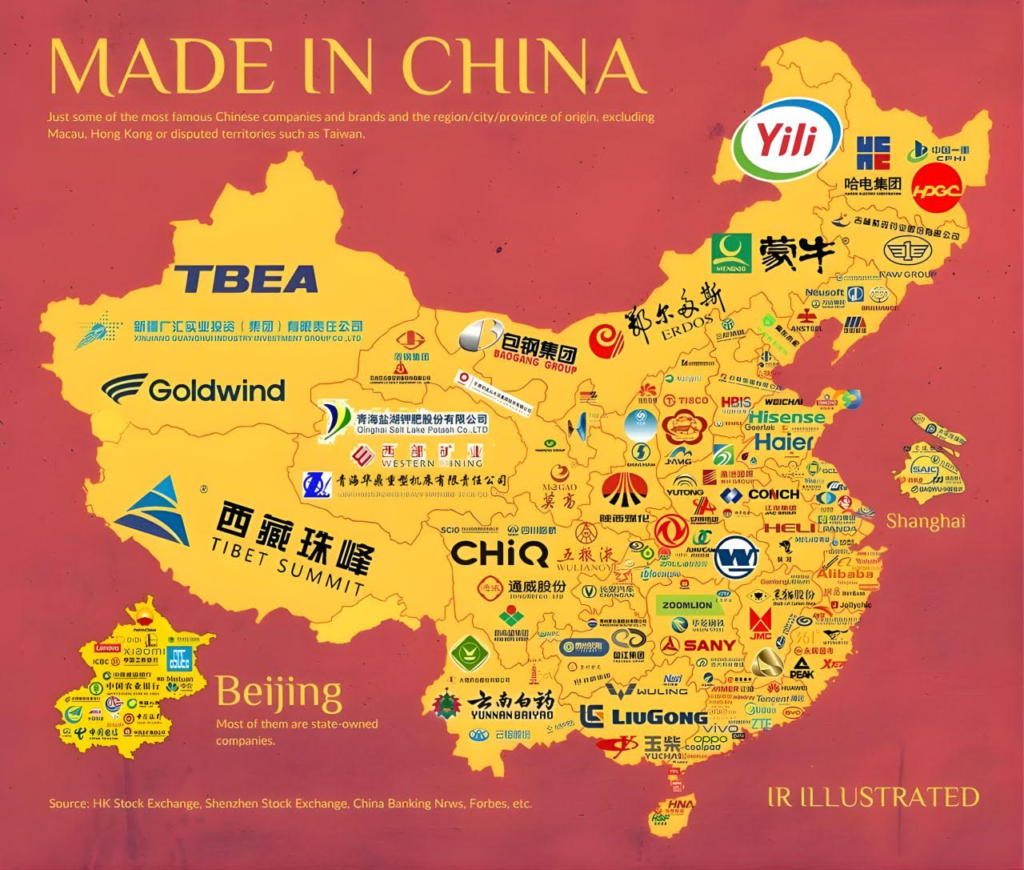
For years, many in the West saw China mainly as the world’s factory: fast, efficient, cost-competitive, but rarely associated with global brand power.
That view is outdated.
What matters now is not only scale, but brand migration. Chinese companies are moving from OEM and cost leadership into technology, design, ecosystem control, and consumer recognition. They are no longer just producing for others. More and more of them are building brands that travel.
And this rise is not coming from one city alone. It is being built by regional clusters across China:
Huawei and Tencent from Shenzhen
Alibaba from Hangzhou
Lenovo from Beijing
Haier and Hisense from Qingdao
Geely from Taizhou
BYD from Shenzhen
These cities did not just produce factories. They produced ecosystems.
What is especially interesting now is the split between two groups.
The first group already includes widely recognized overseas brands. Lenovo, Haier, Hisense, Huawei, and increasingly BYD are no longer just Chinese success stories. In many categories, they are already serious global players with strong visibility far beyond China.
The second group is now pushing harder into Western markets. Brands such as Changan, Pop Mart, CHAGEE, Xiaomi, and others are expanding aggressively, testing whether Chinese companies can move beyond price and scale into long-term consumer loyalty and brand equity in Europe and North America.
That is the real shift.
China is no longer only exporting products. It is exporting brands, retail formats, consumer IP, and operating models.
Anyone still speaking about China only as a low-cost production base is looking at yesterday, not tomorrow.